YOGYAKARTA – Mudskippers are unique fish that can live both in water and on muddy surfaces, making them distinctive inhabitants of coastal ecosystems. Commonly found in mangrove forests and intertidal zones, these fish play an important role in coastal biodiversity. However, similarities in physical appearance among different species can make accurate identification challenging when relying solely on morphological characteristics.

Through the 2026 International Partnership Research and Publication Collaboration Grant from the Faculty of Biology, Universitas Gadjah Mada (UGM), a research team is investigating the species diversity, evolutionary relationships, and population genetic variation of mudskippers from Central Kalimantan and Riau, Indonesia. The research is led by Prof. Dra. Tuty Arisuryanti, M.Sc., Ph.D., from the Laboratory of Genetics and Breeding, together with Dr. Dwi Sendi Priyono and Dr. Rury Eprilurahman, M.Sc., from the Laboratory of Animal Systematics, and Zuliyati Rohmah, S.Si., M.Si., Ph.D. Eng., from the Laboratory of Animal Developmental Structure. The team also involves master’s student Riski Alfikri and international collaborator Assoc. Prof. Julian Ransangan from the Borneo Marine Research Institute, Universiti Malaysia Sabah, Malaysia. This collaboration is particularly important because understanding biodiversity requires expertise from different scientific fields. Combining knowledge in genetics, animal systematics, and developmental biology enables a more comprehensive investigation of species identity and evolutionary relationships. The involvement of an international partner from Universiti Malaysia Sabah also strengthens scientific exchange, research expertise, and collaboration in studying coastal biodiversity across Southeast Asia.
The research uses DNA barcoding based on the mitochondrial cytochrome c oxidase subunit I (COI) gene. This molecular approach helps researchers identify species through their genetic information and investigate relationships among species, as well as genetic variation within populations. In three sampling locations in West Kotawaringin Regency, Central Kalimantan—Sungai Bakau Mangrove Forest, Kubu Coast, and Keraya Coast—the researchers identified three mudskipper groups: Periophthalmodon schlosseri, Periophthalmus chrysospilos, and one species belonging to the genus Boleophthalmus. An interesting finding emerged from the genetic analysis of the Boleophthalmus specimens. DNA similarity searches using Basic Local Alignment Search Tool (BLAST) and the Barcode of Life Data System (BOLD) showed 99–100% similarity to the reference species Boleophthalmus boddarti. However, further analysis of phylogenetic and evolutionary relationships indicated that these specimens were more closely related to Boleophthalmus pectinorostris. This finding raises the possibility that the specimens represent a candidate species that has not yet been accurately identified. Further investigation combining genetic and morphological evidence is needed before its taxonomic status can be established.
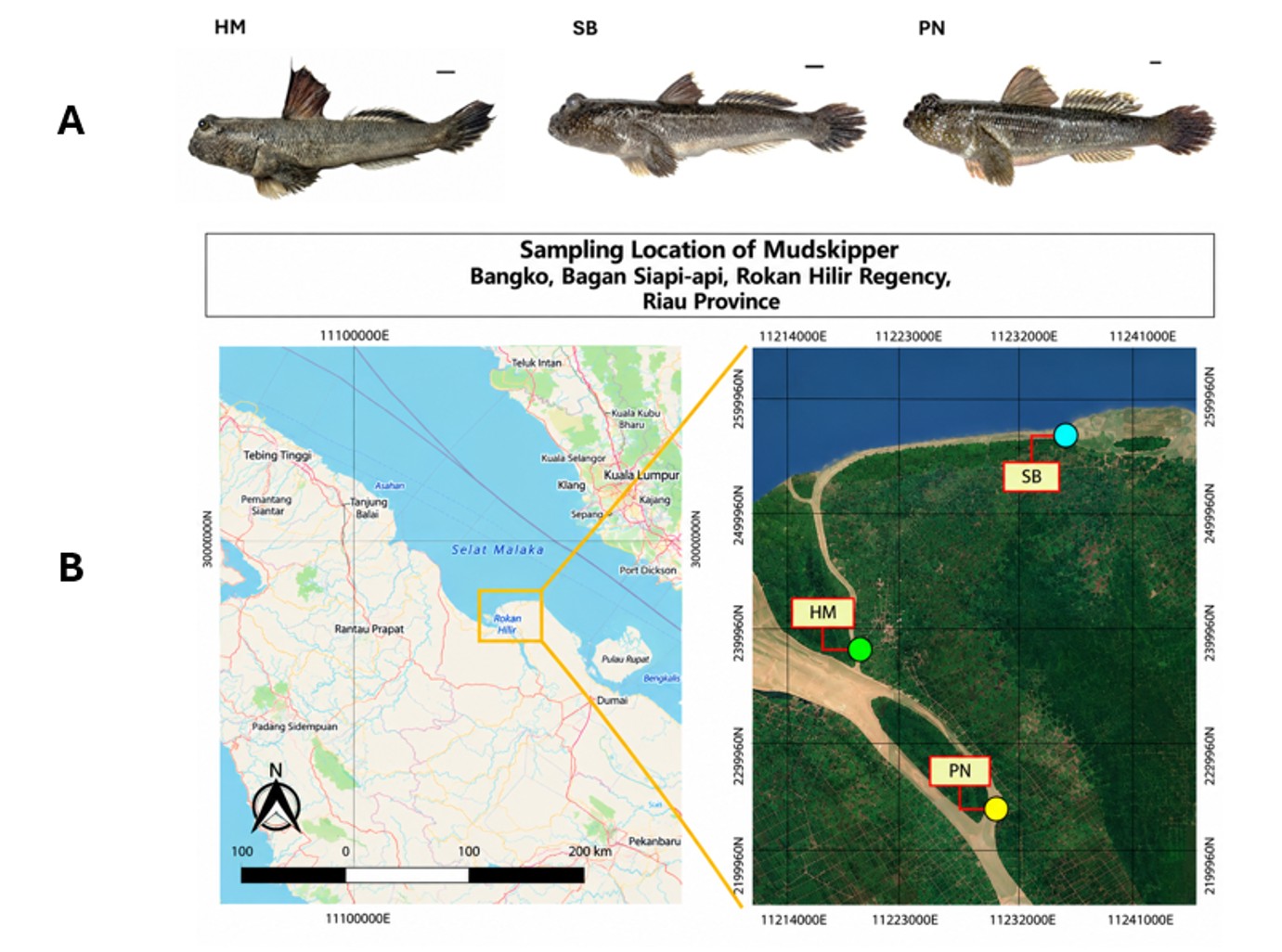
In Rokan Hilir, Riau, mudskippers collected from three locations—Rokan Mangrove Forest, Sungai Bakau Sinaboi, and the Rokan River—were identified as Periophthalmodon schlosseri. Analysis of 30 individuals revealed 10 genetic haplotypes, with an overall haplotype diversity of 0.786. All detected genetic variation occurred within populations, with no significant genetic differentiation among the three sampling sites based on the COI marker. These results provide initial evidence of relatively high genetic variation without detectable genetic separation among the studied locations.
The research findings were also presented through a scientific poster exhibition at the Faculty of Biology UGM Research Day, held on 19–21 November 2026. In addition, the research results have been submitted to a reputable international journal, marking a further step toward sharing the findings with the international scientific community. These findings provide valuable baseline information for understanding mudskipper biodiversity and population dynamics in Indonesian coastal ecosystems. The genetic data are expected to enrich national DNA barcoding resources and support future conservation and sustainable management strategies for coastal biodiversity.
The research contributes to Sustainable Development Goal 14 (SDG 14): Life Below Water, which promotes the conservation and sustainable use of oceans, seas, and marine resources. By bringing together researchers from different laboratories, a graduate student, and an international research partner, the Faculty of Biology UGM strengthens the role of scientific collaboration in protecting biodiversity and supporting the sustainability of coastal ecosystems.