Yogyakarta, April 25, 2026 – The Master’s Program in Biology, Faculty of Biology, Universitas Gadjah Mada conducted a field course for the Ethnobiology subject at the Prambanan Temple area on Saturday, April 25, 2026. This activity is part of strengthening contextual learning, integrating an interdisciplinary approach between biology and culture.
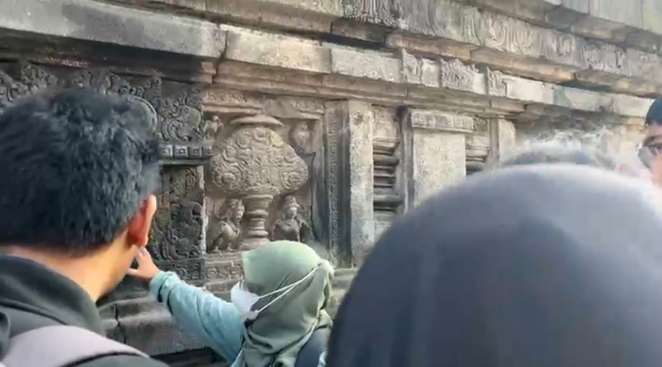
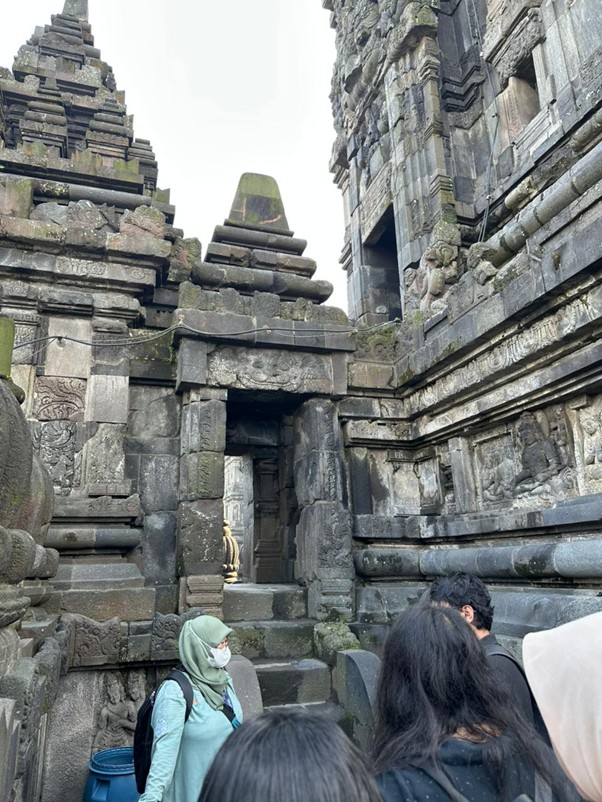
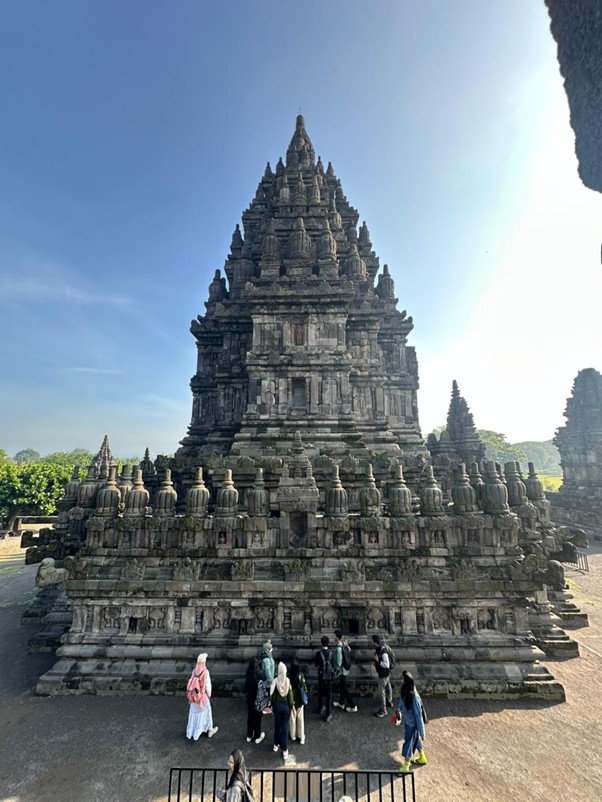
The course is under the academic coordination of Prof. Dr. Ratna Susandarini, M.Sc., who serves as the course coordinator, with Zuliyati Rohmah, S.Si., M.Si., Ph.D. Eng. as one of the lecturers facilitating the implementation of this field course. In her capacity as coordinator, Prof. Ratna Susandarini plays a strategic role in designing the direction of learning, ensuring alignment with learning outcomes, and comprehensively integrating ethnobiological approaches into the Master of Biology curriculum.
This activity utilizes temple reliefs as a source of scientific data to explore human–fauna relationships from historical and cultural perspectives. Students conducted direct observations of animal representations depicted in reliefs illustrating the stories of Ramayana and Krisnayana, two important narratives in classical Javanese tradition.
Through this activity, students not only identified the morphological forms of fauna depicted in the reliefs but also analysed their symbolic, ecological, and cultural meanings. This approach demonstrates how past local knowledge systems recorded human interactions with biodiversity in visually rich and meaningful forms.
In her statement, Dr. Rohmah emphasized that ethnobiology provides space for students to understand biodiversity more holistically. “Temple reliefs serve as cultural archives that document how past societies observed, recognized, and assigned meaning to the fauna around them. This represents a form of knowledge that remains highly relevant to be studied in the context of modern biology,” she stated.
This activity also supports the implementation of Outcome-Based Education (OBE), particularly in strengthening critical analytical skills, interdisciplinary synthesis, and interpretation skills based on field data.
Furthermore, this activity contributes to the achievement of several Sustainable Development Goals (SDGs), including SDG 4 (Quality Education): through experiential, field-based learning. SDG 11 (Sustainable Cities and Communities): by utilizing cultural heritage sites as learning resources. SDG 15 (Life on Land): by increasing awareness of biodiversity, and SDG 13 (Climate Action): through strengthening environmental literacy and human–nature relationships.
This activity reaffirms the commitment of the Master’s Degree Program in Biology at UGM to delivering integrative, contextual, and sustainability-oriented biological education, positioning culture as an essential component in understanding life systems.