Saturday, October 17, 2026 | Cairo, Egypt
On Saturday, October 17, 2026, six students from the Faculty of Biology, Universitas Gadjah Mada (UGM), participated in an academic visit to the Veterinary Serum and Vaccine Research Institute (VSVRI) in Cairo, Egypt. The visit was part of the ProAct Summer School and the One Health One World Conference, held at Badr University in Cairo (BUC), as part of a DAAD-funded initiative promoting intercontinental academic collaboration.
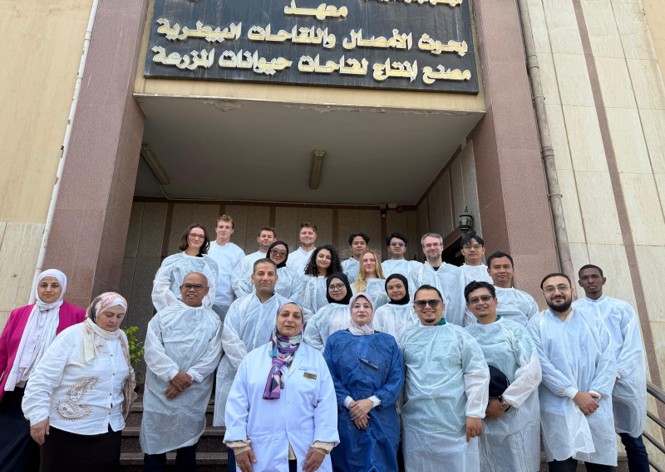
The visit also involved six students from the Faculty of Veterinary Medicine, Leipzig University, Germany, accompanied by faculty members from both countries. The UGM delegation was accompanied by Dr. Sukirno, S.Si., M.Sc., Dr.rer.nat. Abdul Rahman Siregar, S.Si., M.Biotech., Dr. Dwi Sendi Priyono, S.Si., from the Faculty of Biology, and Prof. dr. Tri Wibawa, Ph.D., Sp.M.K. (K), representing UGM One Health collaboration center..
The visit aimed to broaden students’ knowledge and understanding of veterinary vaccine production, covering the entire process from initial development to the final product. During the visit, students had the opportunity to observe two vaccine production approaches: the production of inactivated whole-pathogen vaccines for foot-and-mouth disease (FMD) and embryonated egg-based vaccine production for avian influenza.
UGM Faculty of Biology students, together with students from Germany and accompanying faculty members, during their academic visit to VSVRI, Cairo, Egypt (October 17, 2026).
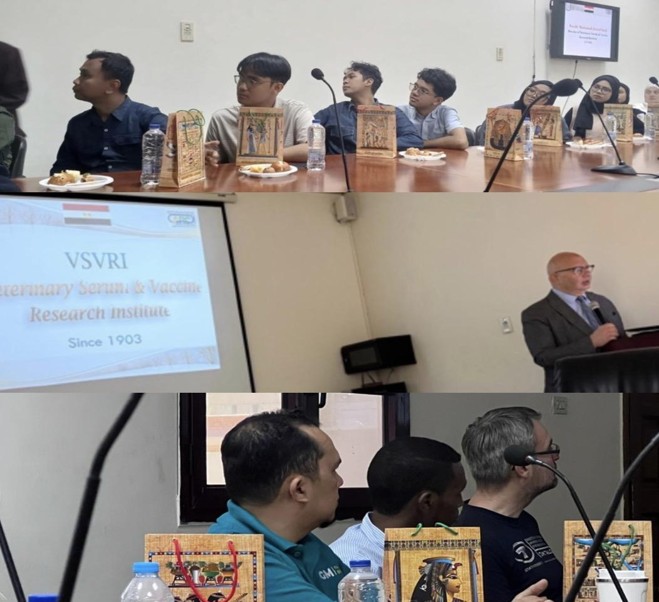
The visit began with a presentation by the Director of VSVRI, who introduced the institute’s profile, research areas, and strategic role in supporting the prevention and control of animal diseases through vaccine research, development, and production.
The Director of VSVRI presents an overview of the institute and its activities before the tour of the vaccine production facilities in Cairo, Egypt (October 17, 2026).
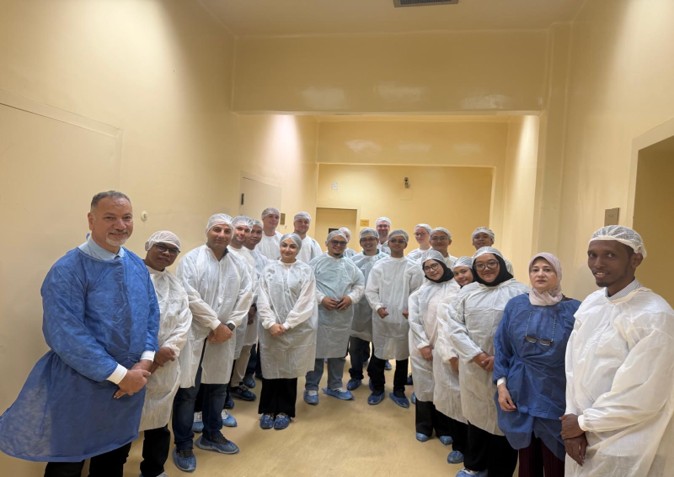
Following the introductory session, participants were given the opportunity to visit two vaccine production facilities. The first visit focused on the production of inactivated whole-pathogen vaccines. During this session, participants learned about the various stages of vaccine production, from the use of pathogens as starting materials and the inactivation process to product quality control. They also gained insights into the importance of standardized production procedures in ensuring the safety, quality, and efficacy of the vaccines produced.
The visit continued to the embryonated egg-based vaccine production facility. At this facility, participants learned how embryonated eggs are used as biological systems for viral propagation, particularly for avian influenza viruses, in the production of vaccines designed to prevent diseases in poultry. In addition to understanding the production stages, participants gained valuable insights into various technical aspects, including the control of production conditions and quality assurance measures necessary to maintain vaccine safety and quality.
Through this academic visit, students gained valuable learning experiences that bridged theoretical knowledge acquired in the classroom with the practical application of technology in the vaccine industry, particularly in veterinary medicine. The visit further enhanced their understanding of microbiology, virology, immunology, and biotechnology while broadening their perspectives on the contribution of biological sciences to the development of sustainable health technologies.
This activity aligns with the One Health approach, which recognizes human, animal, and environmental health as interconnected and interdependent. Furthermore, it contributes to the achievement of the United Nations Sustainable Development Goals (SDGs), particularly SDG 3 (Good Health and Well-being), by strengthening disease prevention efforts and advancing animal health technologies, and SDG 17 (Partnerships for the Goals), by fostering international partnerships and academic collaboration.