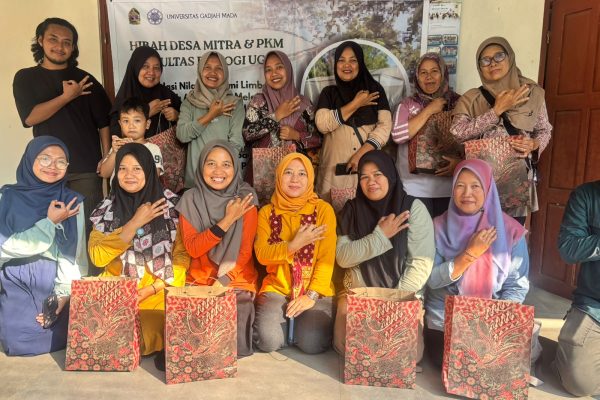
On Saturday (June 27th), The Community Service Team from the Faculty of Biology, Gadjah Mada University, held a training on hard candy and chrysanthemum tea production, and chrysanthemum plant pest management in Kedungpoh, Nglipar, Gunungkidul Regency. The team consisted of several lecturers and undergraduate, graduate, and doctoral students. In the first training, the team was represented by Dr. Dwi Umi Siswanti, S.Si., M.Sc., Aqil Abyan Rahman, S.Si., and Agil Faiqotul Iqbaliyah (graduate students), as well as Kaka Pria Ananta (graduate student). Participants were members of the Al Barokah Home Industry and the Family Welfare Movement (PKK) of Kedungpoh Village.
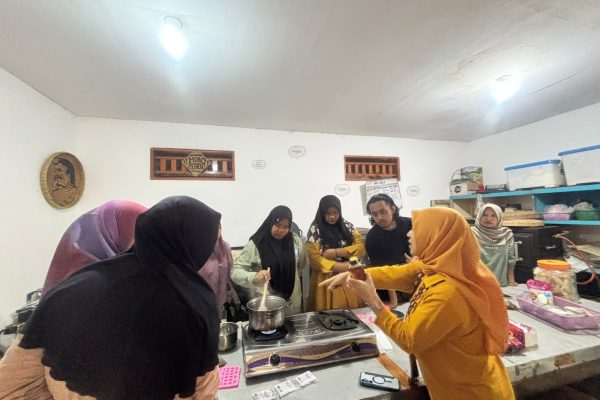
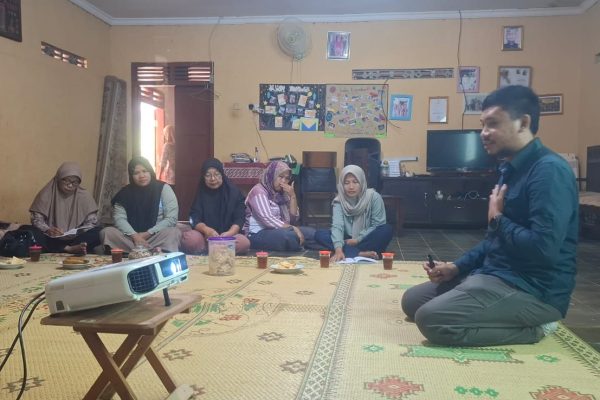
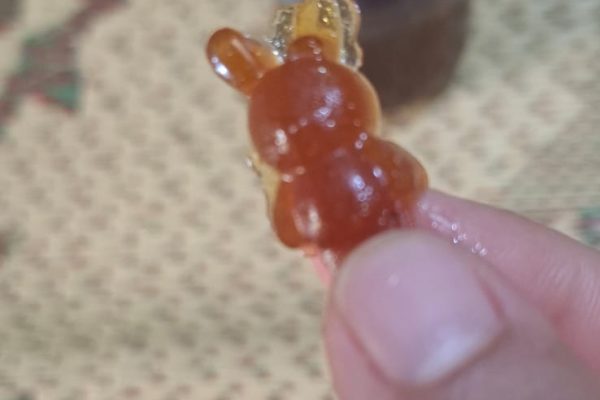
Dwi Umi and Agil provided training on making hard candy and tea from chrysanthemum flowers, while Aqil and Kaka provided training on biological pest control for chrysanthemum plants. The basic ingredients for hard candy are chrysanthemum syrup, isomalt, sugar, citric acid, and water. Chrysanthemum syrup is made from 45 grams of dried chrysanthemums cooked with sugar, citric acid, and water. Research by Marlyn Dian Laksitorini, M.Sc.Apt., Ph.D., and Dr. Dwi Umi Siswanti, S.Si., M.Sc., published in the Traditional Medicine Journal, indicates that chrysanthemums have high antioxidant activity and can increase intelligence in childhood. Making this hard candy will simplify the intake of children aged one to five years. Chrysanthemum tea is made simply by drying chrysanthemum flowers that are still slightly open. Chrysanthemum tea can be brewed directly with hot water or extracted and made into tea bags.
Cultivating chrysanthemums at lower elevations requires diligence and vigilance against insect pests, including thrips, stem borer, whiteflies, ladybugs, caterpillars, red mites, and wood locusts. Whiteflies and red mites are the most important concerns in greenhouse chrysanthemum cultivation systems because they easily enter through small holes and are easily penetrated by wind. These pests, commonly known as plant pests (OPT), can be managed biologically using garlic, certain litters, and predatory insects such as parasitic wasps to control stem miners. “If we find these parasitic flies around the greenhouse, don’t rush to exterminate them, because they prey on stem borer,” said Aqil.
The presentation by the two speakers concluded with a hands-on demonstration of making hard candy and chrysanthemum tea at the Al Barokah Production House. The participants enjoyed the hard candy, and some took it home as souvenirs for their children. “We have been assisting the Kedungpoh community since 2019 and hope that one day this village will be independent and advanced economically, agriculturally, and in terms of welfare,” said Dwi Umi, closing her presentation. This activity is the embodiment of SDG-1 (No Poverty), SDG-2 (Zero Hunger), SDG-3 (Healthy and Prosperous Lives), SDG-5 (Gender Equality), SDG-12 (Responsible Consumption and Production), and SDG-17 (Partnerships to Achieve the Goals). (DUS)