Kulon Progo, August 25th 2026 – The Community Service (PKM) Team of the Faculty of Biology at Gadjah Mada University (UGM), chaired by Prof. Dr. Budi Setiadi Daryono, M.Agr. Sc., once again held a community outreach event as part of its ongoing commitment to the program titled “Empowering the Hargowilis Community Through Modern Native Chicken Breeding and Rearing Technology Based on a Circular Economy as a Self-Sustaining Core-Plasma Model,” which began last June. Funded through the 2026 BIMA Grant from the Ministry of Education, Culture, Research, and Technology (Kemdiktisaintek) under the Community Partnership Empowerment (PKM) Scheme, this program is implemented in collaboration with the Reka Amartani Livestock Group in Hargowilis Village, Kokap Subdistrict, Kulon Progo Regency, Special Region of Yogyakarta.
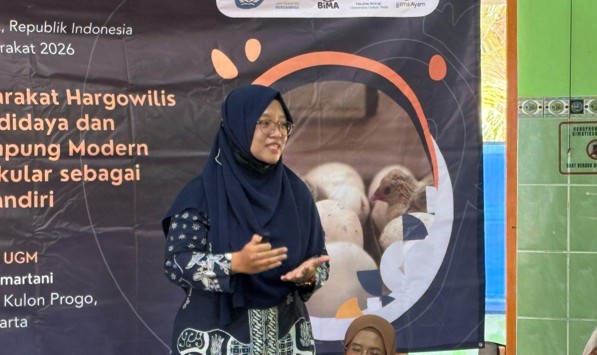
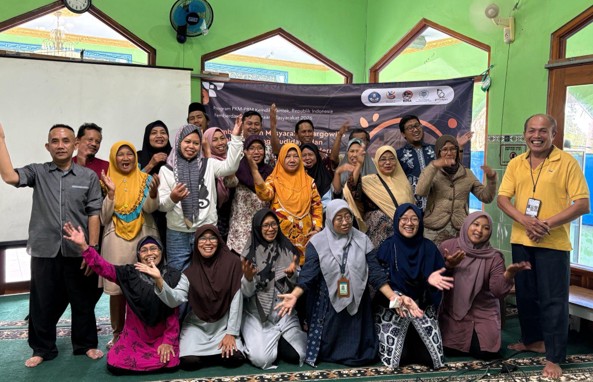
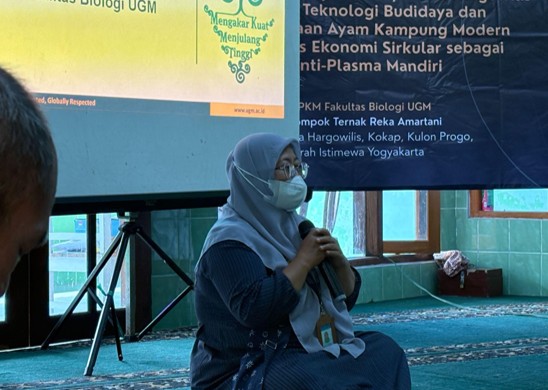
This outreach activity focused on discussing the types of diseases that can potentially affect chickens and appropriate prevention techniques. The event began with a warm welcome for the residents of Hargowilis and the completion of the participant attendance list. Before moving on to the technical presentation, the community was guided through a pre-test to assess their initial understanding of livestock health management.
The presentation session began with a topic on disease risks in poultry and preventive measures, featuring Dr. Eng. Atikah Fitria Muharromah, S.Si., M.Eng. In her presentation, Dr. Atikah discussed various types of pathogens that cause diseases in poultry, including those triggered by viral infections such as Newcastle Disease, Avian Influenza, Fowl Pox, and Marek’s Disease, as well as those caused by bacteria such as Chronic Respiratory Disease (CRD), Snot, and Fowl Cholera. Furthermore, Dr. Atikah emphasized the importance of implementing strict biosecurity and coop sanitation management to break the chain of disease transmission. “To achieve optimal livestock success, hygiene and disease prevention are crucial,” Dr. Atikah stated.
The next session was presented by Ms. Zuliyati Rohmah, S.Si., M.Si., Ph.D.Eng., who explained the chicken egg hatching process and its supporting components. To optimize chicken embryo development, several factors must be considered, including temperature, humidity, ventilation, and egg rotation.
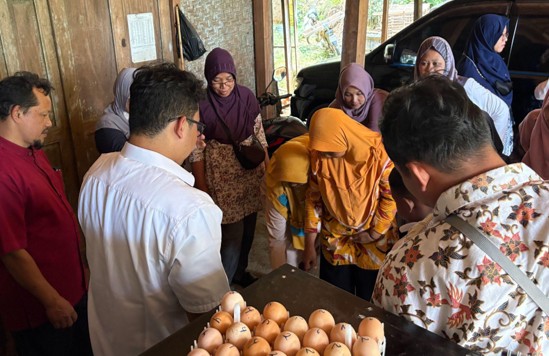
After the presentation session ended, the UGM Faculty of Biology’s Community Service (PkM) team invited the partner community members to move to the home of Mr. Sukaryono, Chair of the Reka Amartani Livestock Group, to observe the use of a dual-input incubator. This session was led directly by Ms. Zuliyati Rohmah, S.Si., M.Si., Ph.D.Eng., using an incubator produced by Mandiri Farm, a poultry farming group based in Cilacap. “This dual-input incubator is well-suited for areas with an unreliable electricity supply because it has two heat sources with an automatic energy-source switching system,” explained Ms. Zuliyati as she demonstrated how the machine works. During this session, the community members observed and were guided step-by-step through the process of using the incubator, from the initial placement of the eggs until they finally hatched.
Next, a symbolic distribution of modern native chicken breeding packages, consisting of 2 roosters and 3 hens, was held for three participants: Mrs. Suyati, Mr. Mohari, and Mrs. Parmawati. The entire series of outreach activities officially concluded with the signing of the Asset Handover Minutes (BAST) by the Chair of the Reka Amartani Poultry Group, Mr. Sukaryono.
Through this activity, the PkM team successfully gathered comprehensive data and field experience as a sustainable step in implementing the community partnership empowerment program. Collaboration among academics, industry, livestock farmers, and the community is expected to promote and support the achievement of the Sustainable Development Goals (SDGs), particularly SDG 2 (Zero Hunger), SDG 8 (Decent Work and Economic Growth), SDG 9 (Industry, Innovation, and Infrastructure), and SDG 12 (Responsible Consumption and Production) through the development of practical and sustainable technological innovations in modern native chicken farming.
This activity was fully supported by the Community Engagement (PkM) team of the UGM Faculty of Biology, which involved students from various academic levels, including Adib Fakhruddin Yusuf (Doctoral Program), Vida Rahma Latifah (Master’s Program), as well as Yusuf Febrianta, Prananda Imammuddin Dzaki, Avriena Lintang Aulia Riefa’i, Azra Belva Naprilian, Intan Nur Aprilia, Ziyan Fareysa Abharani, Nadhifa Aghmia Zain, and Nur Fatimah Ratna Handayani (Undergraduate Program).