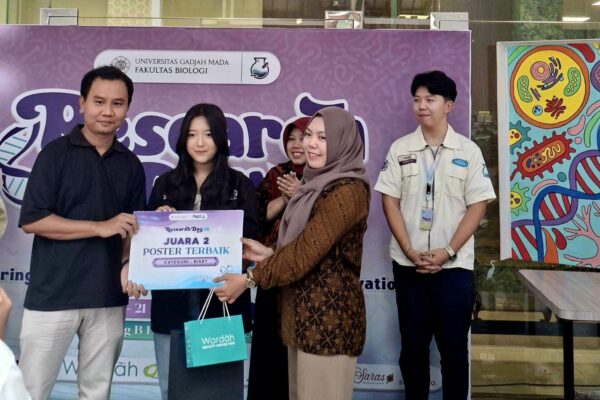
Yogyakarta, November 27, 2026 – The Faculty of Biology, Universitas Gadjah Mada (UGM), together with Universiti Tun Hussein Onn Malaysia (UTHM), has assembled the complete mitochondrial genome (mitogenome) of the Asian small-clawed otter (Aonyx cinereus) from an individual originating in Indonesia. The research, conducted from March to November 2026, was carried out under the International Partnership Research and Publication Grant scheme of the UGM Faculty of Biology. Its aim is to provide genetic reference data to support the conservation of this protected species. The preliminary results were presented at Research Day 26 of the UGM Faculty of Biology, where they won Second Place for Best Poster in the Research Category.



The Asian small-clawed otter is the smallest otter species in the world. Living in rivers, riparian areas and wetlands, it is listed as Vulnerable on the IUCN Red List, included in CITES Appendix I, and protected by law in Indonesia. Its populations are declining due to illegal trade and habitat loss, and Indonesia is recorded as one of the main source countries in the otter trade. Yet genetic data on Indonesian populations remain very limited. Previous studies have mostly relied on short fragments of DNA, which are not sufficient to trace the species’ evolutionary history or to define conservation management units.
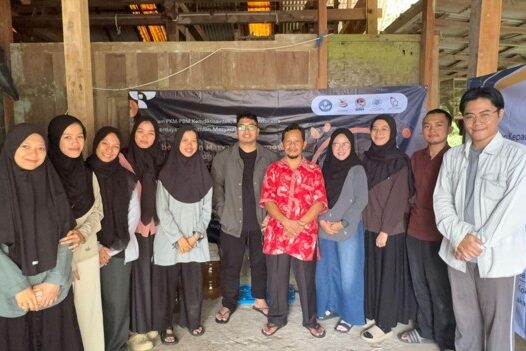
This is the gap the team set out to fill. The research is led by Dr. Dwi Sendi Priyono, S.Si., M.Si., a lecturer at the Animal Systematics Laboratory, UGM Faculty of Biology. He collaborates with Assoc. Prof. Ts. Dr. Muhammad Abdul Latiff Bin Abu Bakar of the Faculty of Applied Sciences and Technology, UTHM, whose expertise covers biodiversity, wildlife ecology and management, and population genetics. The team also includes two students: Adelia Yusuf Ardhani from the Undergraduate Program in Biology and Farach Najad Izzati, S.Pd. from the Master’s Program in Biology. Within this collaboration, the UGM team was responsible for designing the sampling protocol, interpreting the biogeography and formulating conservation recommendations, as well as handling the laboratory and bioinformatic analyses.
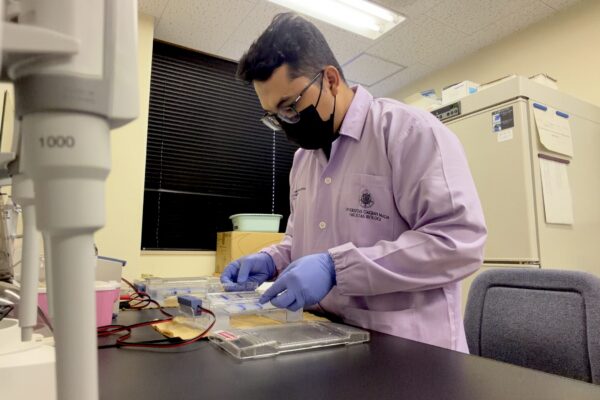
The study began with a single wild otter that had been swept away by a flood and caught by local residents in March 2026. A veterinarian [TO BE CONFIRMED: name and institution] aseptically collected a small piece of ear tissue without causing the animal serious harm, accompanied by the head of the laboratory, Dr. Rury Eprilurahman, S.Si., M.Sc. This small biopsy technique was chosen because it yields high-quality DNA without the need to keep or treat the animal. The sample was then preserved in ethanol and examined at the Animal Systematics Laboratory, UGM Faculty of Biology, where its DNA was extracted.
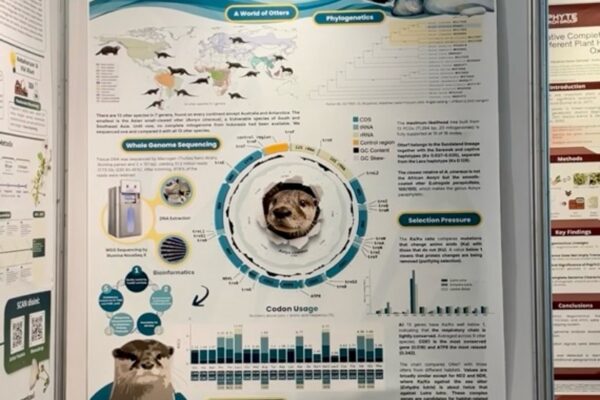
The DNA was then read using whole genome sequencing on the Illumina platform, producing around 51.2 million DNA reads. This amount of data is in fact too small to assemble the otter’s entire nuclear genome. However, mitochondrial DNA is present in hundreds to thousands of copies in every cell, so it is read far more often. From these data, the team assembled a complete circular mitogenome of 16,334 base pairs containing 37 genes. Each position in the genome was read more than 120 times on average, with no gaps or ambiguous bases, making the sequence suitable as reference data. This achievement also inspired the team’s poster tagline: the world’s smallest otter, “decoded” in 16,334 letters of DNA.
Further analyses produced several interesting preliminary findings. Comparison with data from other countries shows that this Indonesian individual carries a Sundaland mitochondrial lineage, closely related to otters from Sarawak, Malaysia, but clearly distinct from the population in Laos on the Indochinese mainland. Phylogenetic analysis also shows that the Asian small-clawed otter is most closely related to the smooth-coated otter (Lutrogale perspicillata), rather than to the African Aonyx otters. This finding reinforces earlier studies that have questioned the grouping of the genus Aonyx. In addition, the 13 protein-coding genes of this mitogenome proved to be highly conserved, as these genes play a vital role in cellular energy production.
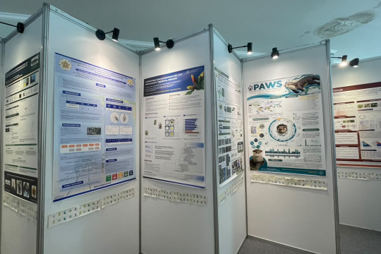
The results were presented as a poster titled “PAWS: Phylogenomic Analysis of The World’s Smallest Otter” at Research Day 26 of the UGM Faculty of Biology, held on 19–21 November 2026 in Building B of the UGM Faculty of Biology. The poster, designed by Adelia Yusuf Ardhani, won Second Place for Best Poster in the Research Category. The award recognises the team’s ability to present complex genomic research in an engaging and accessible way, and highlights the active role of students in international collaborative research.
This research contributes directly to SDG 15 (*Life on Land*). The mitogenome can serve as a reference for identifying the origin of otters confiscated from illegal trade, supporting law enforcement, and providing a basis for defining conservation management units. The partnership with UTHM also reflects SDG 17 (*Partnerships for the Goals*). Cooperation between the UGM Faculty of Biology and UTHM has a long history, including exploratory collaboration in tropical biology, academic exchange activities and plans for a dual degree program. This project extends that network into wildlife genomics research in Southeast Asia, the core range of the species. The involvement of undergraduate and master’s students in every stage of the research supports SDG 4 (*Quality Education*), while the use of next-generation sequencing and bioinformatic analysis strengthens biodiversity research capacity in line with SDG 9 (*Industry, Innovation and Infrastructure*).
Looking ahead, the mitogenome data will be deposited in GenBank so that other researchers can access it, and the team is preparing a scientific manuscript together with its UTHM partner. The research also lays the groundwork for the next stages of the research roadmap, from phylogeographic studies and tracing the origin of otter populations to the development of a validated genetic forensic toolkit. Through cross-border collaboration, the UGM Faculty of Biology seeks to ensure that efforts to protect the Asian small-clawed otter are backed by robust, open and shared scientific data.
Tags: SDG 4 (Quality Education), SDG 9 (Industry, Innovation and Infrastructure), SDG 15 (Life on Land), SDG 17 (Partnerships for the Goals)
Author: Adelia Yusuf Ardhani