Cancer remains one of the leading causes of death worldwide, driving the search for safer and more effective anticancer agents. Natural products continue to be an important source of bioactive compounds, with kaffir lime (Citrus hystrix D.C.) attracting growing attention due to its rich content of secondary metabolites, particularly terpenoids and steroids, which have been reported to exhibit anticancer activities.
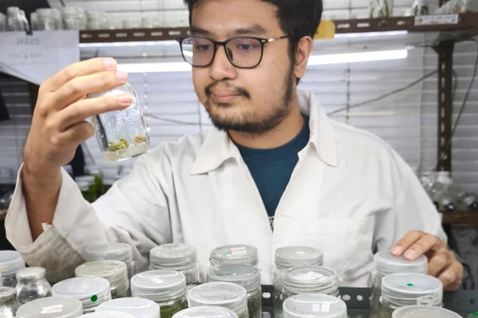

However, the production of secondary metabolites in plants is often inconsistent. Seasonal changes, climate, and environmental conditions can influence both the quantity and composition of bioactive compounds, making it difficult to obtain uniform plant materials. To address this challenge, a research team from the Faculty of Biology, Universitas Gadjah Mada (UGM), is developing a kaffir lime callus culture system as a controlled platform for secondary metabolite production. This approach offers the potential to produce bioactive compounds with greater consistency while reducing dependence on seasonal variation and cultivation conditions.
The research is led by Woro Anindito Sri Tunjung, S.Si., M.Sc., Ph.D., together with Ferdinan Florian, Gabriela Arista Phoebe Sutato, and Grace Leilani Tumiwa, in collaboration with Sastia Prama Putri, Ph.D. from Osaka University, Japan. The study also benefits from scientific input provided by Endre Károly Kristóf, Ph.D. and Rini Arianti, Ph.D. from the Department of Biochemistry and Molecular Biology, Faculty of Medicine, University of Debrecen, Hungary. The research takes place at the Biotechnology and Biochemistry Laboratories, Faculty of Biology UGM, using kaffir lime fruits collected from Pekutan Village, Bayan District, Purworejo Regency, Central Java.
The study begins with in vitro seed germination to obtain sterile seedlings as the source of explants. Callus cultures are subsequently induced from three different explant types, followed by evaluations of their growth characteristics and compound profiles. To stimulate secondary metabolite biosynthesis, the calli are subjected to elicitation treatment before extraction. The resulting compound profiles are then analyzed using Gas Chromatography–Mass Spectrometry (GC–MS) to identify the secondary metabolites produced by the kaffir lime calli.
Unlike conventionally cultivated plants, callus cultures can be maintained throughout the year under controlled conditions, minimizing the effects of environmental fluctuations on metabolite production. This system provides a more consistent source of plant-derived compounds for research and represents an important step toward the development of natural product-based anticancer candidates. The findings are also expected to expand the application of plant tissue culture technology in plant biotechnology research.
This research contributes to Sustainable Development Goal (SDG) 3: Good Health and Well-being by advancing plant-based sources of bioactive compounds with potential applications in health research. It also supports Sustainable Development Goal (SDG) 12: Responsible Consumption and Production by promoting a more sustainable approach to producing valuable plant metabolites through controlled callus culture systems, thereby reducing dependence on harvesting plants from natural populations.