Sleman, September 5, 2026 – The Community Service (PkM) Team of the Faculty of Biology, Universitas Gadjah Mada (UGM), held the activity “Socialization and Mentoring on the Cultivation and Utilization of Black Rice to Support SDGs 2 and 3 in Ending Hunger and Improving Health in Wedomartani, Ngemplak, Sleman” on Saturday, September 5, 2026, from 09:00 to 12:00 WIB at BUMKal Wedo Sembodo, Jl. Tajem, Wedomartani Village, Ngemplak District, Sleman Regency, Special Region of Yogyakarta. The activity, supported by the 2026 Community Service (PkM) Grant funding from the UGM Faculty of Biology, drew 25 participants.
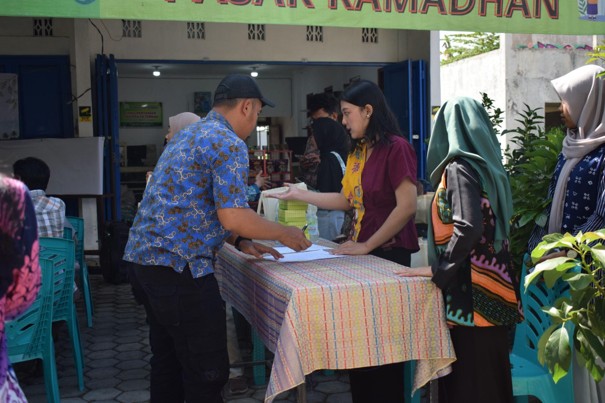
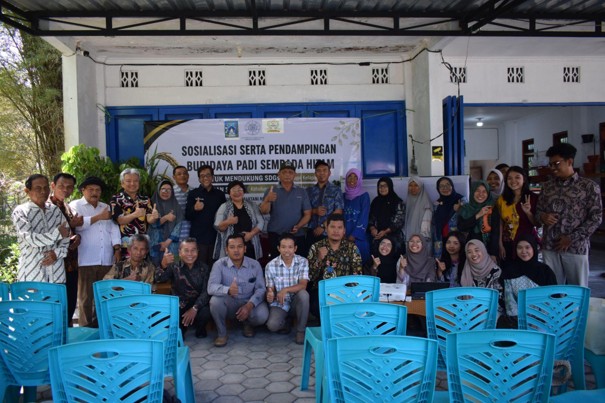
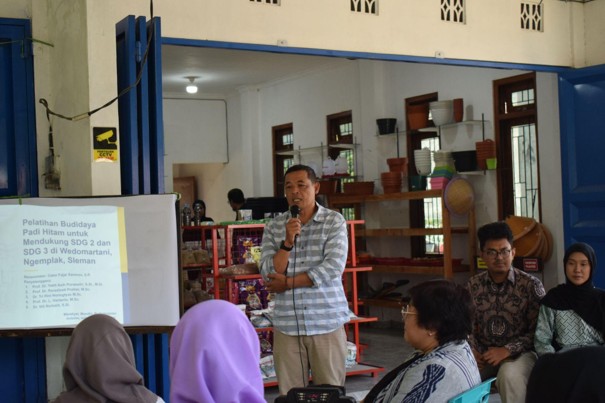
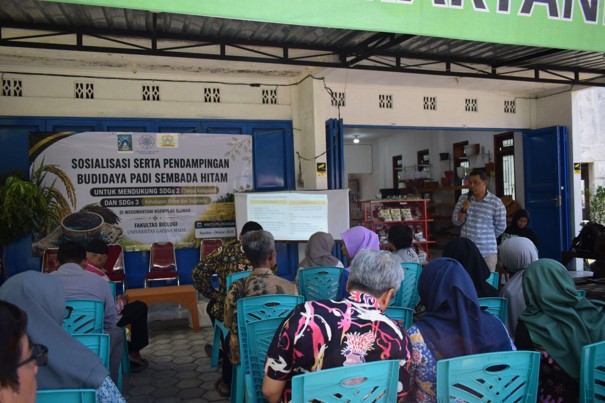
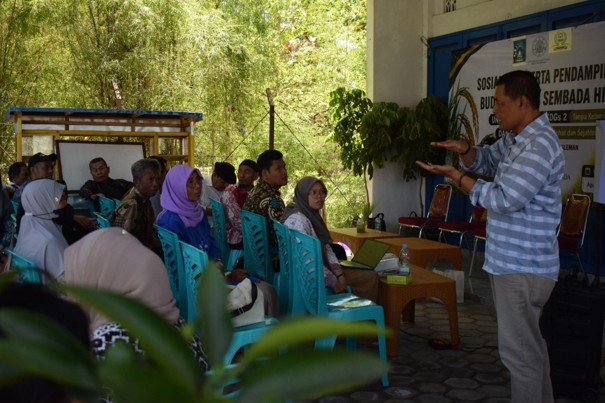
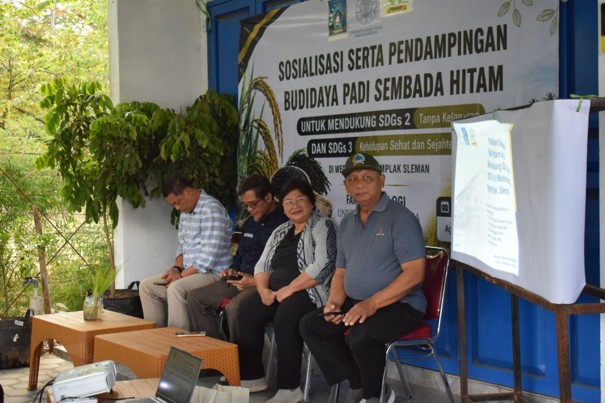
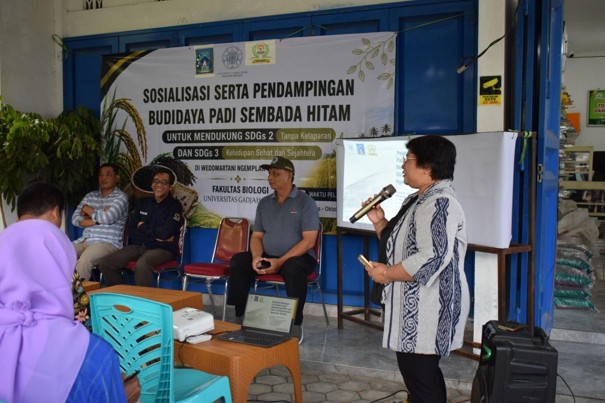
The event began with an opening session, followed by remarks from Prof. Dr. Yekti Asih Purwestri, S.Si., M.Si., as the Lead Proposer of the PkM program and event organizer; remarks from Mr. H. Muhammad Iskandar, S.E., M.E., as Director of BUMKal Wedo Sembodo; and remarks from Mr. H. Teguh Budianto as the Village Head (Lurah) of Wedomartani. The event then proceeded to its main session, featuring a presentation by the resource speaker, Mr. Catur Fajar Santoso, S.P., from the Agricultural Extension Center (BPP) of Region V Pakem.
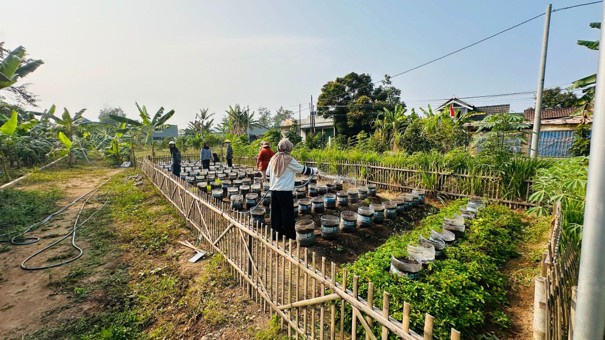
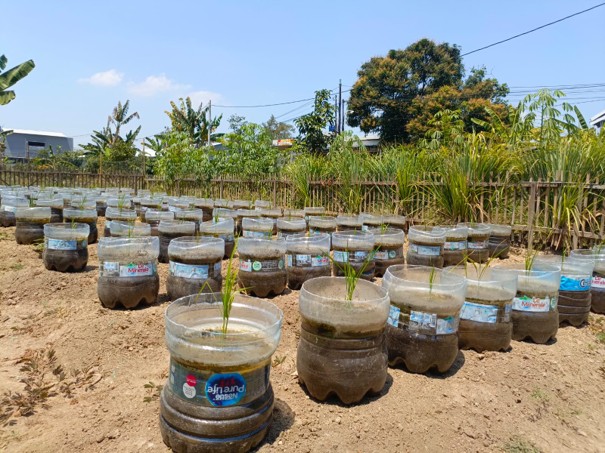
In addition to the material presentation, participants—representatives of Farmer Group Associations (Gapoktan) and Women Farmer Groups (KWT)—were invited to directly observe black rice planting practices that had been carried out on the grounds of BUMKal Wedo Sembodo. Unlike conventional cultivation in paddy fields, this planting was carried out using gallon containers as growing media, introducing an alternative small-scale black rice cultivation method that can be applied even with limited land, while also making water use more efficient during the dry season.
The event was attended by officials of the Wedomartani Village government, namely the Village Head (Lurah) and Village Secretary (Carik) of Wedomartani, along with representatives of Hamlet Heads (Dukuh) from Gondang Legi, Malang Rejo, Bakungan, Sawahan Lor, and Panjen hamlets. Also present were representatives of Farmer Groups from Tongalan, Saren, Sawahan Lor, Blotan, Gebang, Karang Sari, and Gondang Legi, as well as representatives of Women Farmer Groups (KWT) from Sawahan Lor, Malang Rejo, Karang Anyar, and Krangan.
This program was initiated as an effort to strengthen local food security based on black rice, particularly the Sembada variety, a local black rice variety native to Sleman, Yogyakarta. Black rice (Oryza sativa L.) is a superior commodity rich in anthocyanin pigments (antioxidants), fiber, and iron (Fe), and has a low glycemic index that is beneficial for health. Wedomartani itself is an agrarian region with approximately 512 hectares of rice fields. However, the use of black rice as an alternative food source among the community remains limited. Through this socialization and mentoring program, the PkM team hopes that the people of Wedomartani will become more familiar with proper black rice cultivation techniques while also utilizing it as a healthy alternative food source for their families.
In his presentation, Catur Fajar Santoso, S.P., delivered technical material on black rice cultivation, ranging from land preparation and seed selection to plant care, in order to achieve optimal harvest yields.
This activity is part of a series of roadmap programs by the UGM Faculty of Biology’s Community Service Team in Wedomartani Village, in partnership with BUMKal Wedo Sembodo starting in 2026. The team had previously also introduced diversified functional food products based on black rice to the Wedomartani PKK women’s group. The program is coordinated by Prof. Dr. Yekti Asih Purwestri, S.Si., M.Si., as Lead Proposer of the PkM program, together with Prof. Dr. Rarastoeti Pratiwi, M.Sc., Dr. Tri Rini Nuringtyas, M.Sc., and Prof. Dr. Laurentius Hartanto Nugroho, M.Agr., as faculty members.
The implementation of this activity also involved UGM’s pigmented rice research team, namely Dr. Siti Nurbaiti, S.Si., and Nirma Kumalasari, S.Pd., M.Sc., along with undergraduate, master’s, and doctoral students from the UGM Faculty of Biology: Citra Riski Nurhartanti, S.Pd., M.Sc.; Anggraeni Novia Putri, S.Pd., M.Sc.; Cory Rafsyanyani, S.Si., M.Sc.; Alifa Amalia, S.Si., M.Sc.; Ardelia Shafaa Nabiilah; Aura Prista Rukmana; Amelia Ikhsanti; and Ahmed Mortezza, who assisted in facilitating the discussion and mentoring sessions with the farmer groups and KWT.
Participant enthusiasm was evident throughout the activity, particularly during the question-and-answer session discussing practical challenges of cultivating black rice on their respective land, as well as during the direct observation of black rice planting in gallon-based media. This activity stands as a tangible embodiment of the UGM Faculty of Biology’s commitment to supporting the achievement of the Sustainable Development Goals (SDGs), particularly SDG 2 (Zero Hunger) through strengthening local food security based on black rice, and SDG 3 (Good Health and Well-being) through the promotion of functional foods for community health.
Through this socialization and mentoring program, it is hoped that farmers and farmer groups in Wedomartani Village will be able to sustainably develop black rice cultivation, both in paddy fields and alternative growing media such as gallon containers, thereby not only strengthening local food security but also opening new economic opportunities for the community.