Household organic waste remains a significant challenge in community waste management. Through the Community Service (PkM) Waste Management Team in collaboration with the Wedomartani Partner Village in 2026, the Faculty of Biology, Universitas Gadjah Mada (UGM), encouraged the community to learn and practice an alternative method of organic waste utilization via eco-enzyme production. This initiative was realized through the “Extension and Training on Organic Waste Management using Eco-Enzymes in Wedomartani Village,” held on Sunday, September 13, 2026, at the Wedomartani Village Hall, Ngemplak, Sleman, Special Region of Yogyakarta. The program, supervised by Dr. Ardaning Nuriliani, S.Si., M.Kes., was attended by community representatives from three hamlets: Pokoh, Saren, and Wonosari.
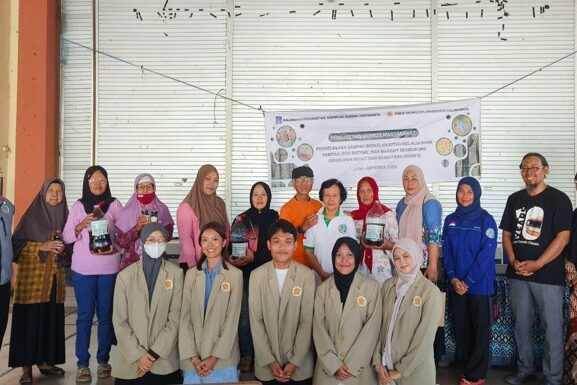
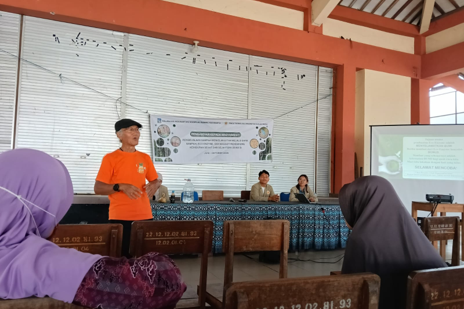
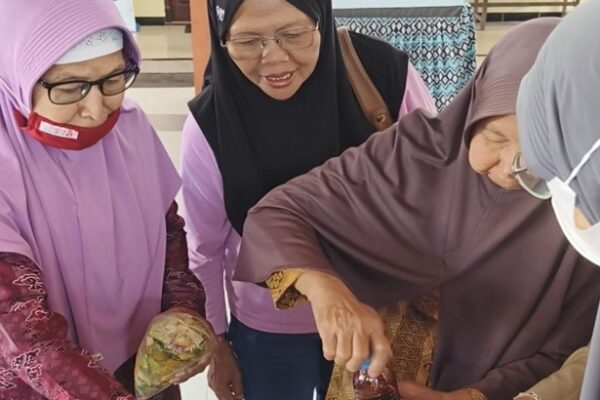
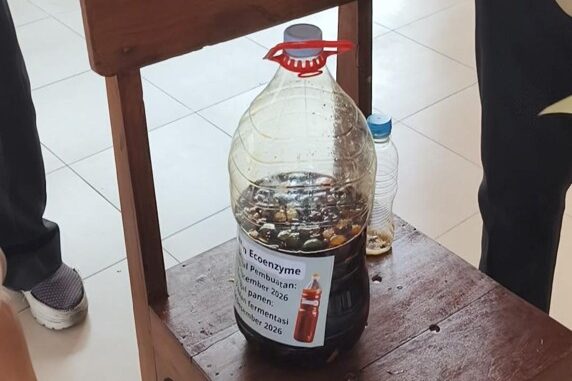
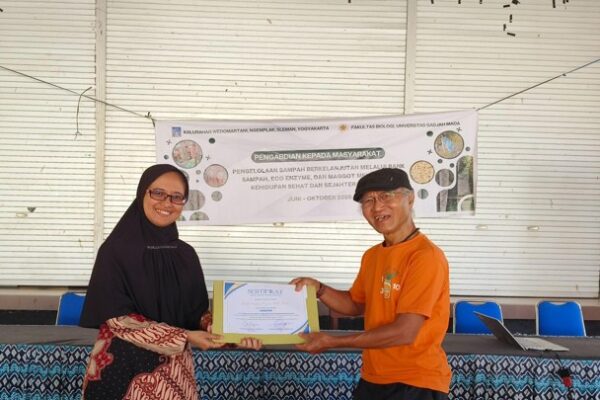
This socialisation and training program was designed to provide the community with both theoretical understanding and practical experience in processing daily organic waste. Eco-enzymes were introduced as a viable method for organic waste utilization, utilizing materials readily available in household environments. Equipped with the acquired knowledge and experience, the community is expected to implement organic waste processing more independently within their respective neighborhoods. The recycling of these organic residues constitutes an application of Sustainable Development Goal (SDG) 12 (Responsible Consumption and Production) in household-level waste management.
The event commenced with an opening ceremony and welcoming remarks from the UGM Faculty of Biology Waste Management PkM Team. The agenda proceeded with a presentation by PkM team members regarding organic waste management and its utilization through eco-enzyme production. During this session, Mr. Budhi Hendro Prijono, A.M.K., S.K.M., from the Nusantara Eco-Enzyme Community, contributed additional insights and explanations based on his practical experience in eco-enzyme management. Representatives from the Nusantara Eco-Enzyme Community were also present to support the program’s implementation. The active involvement of the PkM Team, the Nusantara Eco-Enzyme Community, and the local residents in this activity embodies SDG 17 (Partnerships for the Goals) through collaborative knowledge and experience sharing in organic waste management.
The educational materials covered the introduction to eco-enzymes, their history, benefits, suitable raw materials, and the step-by-step production process. Participants also received instructions on utilizing household organic waste as the primary substrate for eco-enzyme synthesis. The materials were delivered using relatable, everyday examples to help the community understand how typically discarded organic residues can be repurposed through specific processing methods. This capacity-building effort supports SDG 4 (Quality Education) by providing comprehensive education on organic waste processing and its subsequent utilization.
Following the theoretical exposition, participants were guided to engage in hands-on eco-enzyme production. During the practical session, Mr. Budhi Hendro Prijono and the PkM Team assisted the participants, providing supplementary guidance and explanations at each methodological step. High community enthusiasm was evident throughout the event, particularly during the interactive discussion and Q&A session. Participants actively inquired about acceptable raw materials, the fermentation process, and the practical applications of the final eco-enzyme product. To promote program sustainability, participants were provided with mature eco-enzyme samples and informational leaflets detailing eco-enzymes and their production protocols.
This initiative represents a concerted effort by the UGM Faculty of Biology Waste Management PkM Team to introduce waste management practices originating at the household level. By converting organic residues into eco-enzymes, the community is encouraged to better identify their generated waste types and process them prior to disposal. This approach aligns with SDG 11 (Sustainable Cities and Communities) through community-driven environmental waste management. Furthermore, the application of eco-enzymes for specific environmental sanitation needs supports SDG 3 (Good Health and Well-being). It is anticipated that the acquired knowledge and skills will be continuously applied and advanced by the residents of Wedomartani Village as a core component of sustainable waste management. The utilization of organic waste via eco-enzymes also adds functional value to materials previously deemed as refuse. If properly developed, this utilization could generate economic opportunities at the community level, thereby supporting SDG 8 (Decent Work and Economic Growth).
Contributors: The 2026 Waste Management Community Service (PkM) Team of the Faculty of Biology, UGM, in collaboration with the Wedomartani Partner Village, supervised by Dr. Ardaning Nuriliani, S.Si., M.Kes.