SDG 15 : Advance Life On Land
Yogyakarta, July 1, 2024 – A team of students from the Faculty of Biology at Gadjah Mada University has achieved remarkable success by winning 3rd place in the CEWAMA Research Competition organized by the Indonesian Aviation Polytechnic Curug. This national competition ran from May 29 to June 25, 2024, for the scientific writing phase and concluded with final presentations on July 1, 2024.
The team, named “ALNOCO” (Algae Non Carbon), consists of K. William Hendri Panjaitan (class of 2021), K.H. Mahadhevy Ryrathna Vidhantyka (class of 2022), and Aqil Muhammad Hafiz (class of 2021). Under the guidance of Dr. Eng. Thoriq Teja Samudra, M.Sc., and Dr. Eko Agus Suyono, M.App.Sc., they presented a paper titled “INNOVATION OF POME AS A MICROALGAE (Neochloris oleoabundans) SUBSTRATE FOR DIVERSIFICATION OF RENEWABLE AND ENVIRONMENTALLY FRIENDLY AIRCRAFT FUEL DERIVATIVES.”
In their work, the ALNOCO team addressed the issue of alternative bioavtur from microalgae biomass by utilizing waste POME (Palm Oil Mill Effluent) as a growth substrate. The biomass of N. oleoabundans, which is rich in lipid content, can be used as an environmentally friendly and renewable alternative for aircraft fuel. The growth and lipid content of N. oleoabundans are influenced by various factors, including optimal nutritional content (N:P:C). POME waste provides the necessary N:P:C levels for N. oleoabundans to grow and accumulate lipids in its cells.
This innovation has significant potential to support environmentally friendly bioavtur production before 2030, with the support of all parties involved in the next stages of testing, including preparing a roadmap for commercialization, However, further discussion is needed to optimize the growth of microalgae in POME waste and extract lipids for making aircraft fuel that minimally pollutes the air. Additionally, the use of microalgae and POME as alternative options has been proven to be safe to process, fulfilling the need for a clean energy transportation system, which will positively impact the environment.
The competition was attended by 56 teams from various universities across Indonesia. The achievements of the ALNOCO team demonstrate their commitment to developing innovative and applicable research. This success also showcases the Faculty of Biology at Gadjah Mada University’s ongoing efforts to contribute to the development of sustainable science and technology, aligning with UGM’s SDGs goals in the renewable energy field.
Day 1: Introduction to ONT Platform and Basic Bioinformatics
Day 2: Advanced ONT Features and Data Processing
Day 3: Metagenomic Analysis and Final Project
Importance of NGS Analysis in Supporting Biosecurity Topics to Achieve Food Security
The KSAT Pra-Acclimatization II 2024: Enhancing the Scientific Understanding of KSAT Sapling Members
Author: KSAT 2024*
The Nusantara Orchid Biodiversity Show (NOBiS), which is a series of orchid photography competitions and annual webinar, is being held again by the Biology Orchid Study Club (BiOSC), Faculty of Biology, UGM. This webinar is held online with the aim of educating and providing training to the younger generation through seminars and activities workshop. This year’s orchid photography competition has the theme “Orchid Odyssey: Revealing the Extraordinary Journey of Orchids Through The Past, Present, and Future”. A total of 56 participants took part in the orchid photography competition by submitting their work on 7 – 17 May 2024. The results of the participants’ photography work are then displayed in the form of a virtual exhibition via ArtSteps which can be accessed by all participants. The winners of the orchid photography competition at the NOBiS event were Dary Saka Fitrady as First Place, Imaduddin Akhyar Kusumaperdana as Second Place, Yosvaldo Gerry Setiono Putra as Third Place, and Muhammad Nadhif Al Sulthony as Favorite Champion, which was announced at the peak event of the 2024 NOBiS.
The orchid photography competition has a positive impact on sustainable development. Webinar and photography competitions can contribute to the appreciation of biodiversity, which is in line with Sustainable Development Goals (SDGs) 12: Responsible consumption and production, 15: Life on Land, and 17: Partnership to achieve goals. Orchid photography is an effort that can be used as a tool to visualize biodiversity and help remind us of the beauty of nature and the importance of protecting the environment.
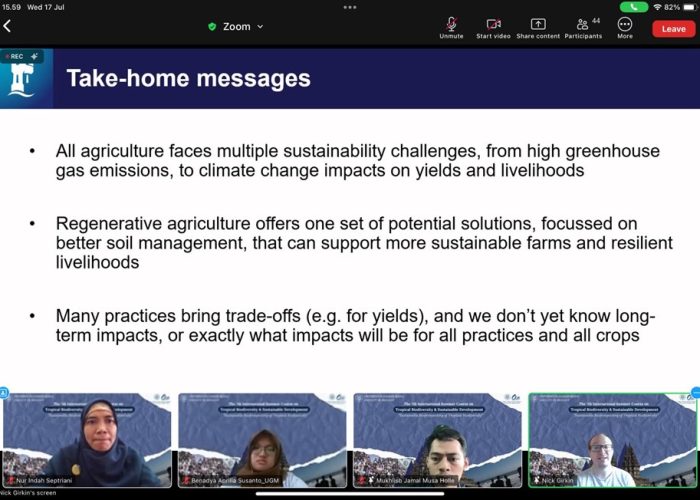
NOBiS webinar event this year carries the theme “Orchid Odyssey: Revealing the Extraordinary Journey of Orchids Through The Past, Present, and Future” with the implementation time on 1st June 2024 at 09.30 online and attended by 144 participants. The NOBiS 2024 webinar aims to provide a means for the public to learn and understand the preservation of orchids in Indonesia through genome editing and tissue culture propagation techniques. Therefore, this year, BiOSC invited three speakers who have become experts in the field of orchids in Indonesia, namely Prof. Dr. Endang Semiarti, M.S., M.Sc., Prof. Dr. Dewi Kusuma, S.P., M.Si., and Dr. André Schuiteman.
Prof. Dr. Endang Semiarti, M.S., M.Sc. is a head of Laboratory of Biotechnology, Faculty of Biology Universitas Gadjah Mada and has research focus on plant tissue culture, plant molecular genetics, plant biotechnology, orchidology, cell and molecular biology. On this occasion, he shared insights regarding Indonesian Orchid Plant breeding with the application of Genome Editing. Current orchid populations in nature are decreasing due to natural disasters, illegal logging, and domestication for collection, decoration, and also for herbal medicine. So we need Ex situ and In situ conservation efforts such as genome editing using CRISPR/Cas9 system as the cheapest and easiest to apply technology, having a revolutionary impact on basic research to study gene function and plant breeding to produce new orchids with plenty of seedlings and early flowering.
Orchid production and conservation also can be supported by the method of plant tissue culture, its delivered by Prof. Dr. Dewi Sukma, S.P., M.Si. as a professor of Agronomy and Horticulture department of Agronomy and Horticulture Faculty of Agriculture IPB University and have research interest in plant genetic diversity, breeding and cultivar development and also in plant genetic engineering. Orchid need tissue culture because its lack of seed endosperm so it can provide a higher number of seedling and provide a sterile ad healthy propagules, tissue culture can be an independent breeding of time and season and also can facilitated the in vitro breeding to maintain the existence and availability of Indonesian orchid for future research and potential uses.
The last topic delivered by Dr. André the research leader in the Asia team of Royal Botanic Garden United Kingdom with the research focus on Taxonomy, Conservation and Evolution of Orchidaceae. The diversity of Indonesian orchid is about 26000 species in 800 genera, but not easy to tell because many species are poorly understood, especially the distribution of species in Borneo and New Guinea. The existence and availability of Indonesian orchid should be maintained because there is a lot of diversity and distribution of it such as Dimorphorchis lowii and Paraphalaenopsis laycockii from Borneo, Bulbophyllum muricatum and Dendrobium azureum from Tanah Papua.
It is hoped that the informative webinar material will broaden the knowledge of orchid lovers as well as introduce BiOSC to the outside as a study group that focuses on orchids with the jargon of “Tumbuh, Berkembang, Lestari”. Nusantara Orchid Biodiversity Show (NOBiS) National Photography Competition
2024: “Orchid Odyssey: Revealing the Extraordinary Journey of Orchids Through The Past, Present, and Future” expected to inspire and encourage deeper understanding of history, uniqueness, preservation, and future challenges faced by orchids. Through photography, Participants are expected to be able to express messages about the existence of orchids in the past, present and future. [Author: BiOSC]